Showing posts with label BSc (Hons) Theologian. Show all posts

Thursday, May 20, 2010

Free Lifetime Membership For Watchman Chew!


In view of the exceedingly impressive statements made by the Watchman Chew in his previous posts, I would offer an absolutely free, no-strings-attached, lifetime membership for Daniel Chew Huicong in the aforementioned club (i.e. see above).

There is also an exciting giveaway of an absolutely free template – only for the first 100 members – to print a name card with. The template outlines the following extraordinary credentials: apologist, author, watchman.

Please print your very own Member's Certificate here.

Tuesday, May 18, 2010

Watchman Chew's Best of Friends are Hell-Bound False Teachers - According to Chew of Course!

Consistent with the spirit of an authoritative, self-appointed Watchman, Daniel Chew Huicong has proclaimed the following in a previous post concerning false teachers:

“We can judge a person's teachings and his/her salvation through whether they teach false doctrines and whether they preach another gospel. This shows definitely that the act of teaching and preaching is a very serious affair, since the teaching of false doctrines would damn us. Note first of all that this teaching of false doctrines is something that happens consistently, that is when the people involved truly do believe in them and thus teach them. However, how are we to find out whether a person who teaches something truly believes in what he teaches, and does not do so honestly out of ignorance? We can discern what a person believes through exposing him/her to the truth, and then noticing the reaction of the person teaching serious errors. If the person is honestly ignorant, that person would immediately repent. If, however, that person remains defiant, and that happens for quite some time, we can know for sure that the person is truly a false teacher and is not saved at all.

In the event that his readers might have missed his point, he emphasized for us that, one of “the fruits by which we can discern heretics and even judge the salvation of others” is the “teaching of false doctrines.”

Well, by putting two and two together, we can derive the following from the infallible teachings of the most venerable, most correct Watchman Chew:

1. One of “the fruits by which we can discern heretics and even judge the salvation of others” is the fruit of “teaching of false doctrines.”
2. “The teaching of false doctrines would damn us.”
3. A genuine false teacher is one who “truly … believe[s] in [the false teachings] and thus teach them.”
4. If the false teacher is ignorant, he would “immediately repent” when exposed “to the truth.”
5. “If, however, that person remains defiant, and that happens for quite some time, we can know for sure that the person is truly a false teacher and is not saved at all.”

Using the aforementioned propositions as proposed and consolidated by the most venerable, most qualified Watchman Chew, we can derive the following fact – many of Chew’s own friends would qualify as a false teacher and are likewise damned to hell.

Why so?

Exhibit One – Joel Tay the Baptist

Chew: I believe pedobaptism is the truth. According to the Law of Non-Contradiction, credobaptism and pedobaptism cannot be both true. Hence, credobaptism is a false teaching. As I have shown from the Scriptures, you are now exposed for who you truly are. Do you immediately repent of the false teaching of credobaptism?

Joel: I truly believe in credobaptism and I teach it. So what’s your problem?

Chew: You have remained defiant, and that had happened for quite some time – at least for the last 5 minutes – so now we can know for sure that you are truly a false teacher and is not saved at all. Remember, the teaching of false doctrines would damn us.

Implication: All Baptists are false teachers and are damned to hell according to Watchman Chew.

Exhibit Two – Pastor Paul Goh the Non-Concentric Cessationist

Chew: Dear Pastor Paul Goh, I believe Concentric Cessationism is the truth. According to the Law of Non-Contradiction, Concentric Cessationism and Non-Concentric Cessationism cannot be both true. Hence, Non-Concentric Cessationism is a false teaching. As I have shown from the Scriptures, you are now exposed for who you truly are. Do you immediately repent of the false teaching of Classical Cessationism?

Paul Goh: I truly believe in Classical Cessationism and I teach it. Don’t you yourself follow the 6 forms of unity? Aren’t you more reformed than me?

Chew: You have remained defiant, and that had happened for quite some time – at least for the last 5 minutes – so now we can know for sure that you are truly a false teacher and is not saved at all. Remember, the teaching of false doctrines would damn us.

Paul Goh: But your good friend and fellow blogger Pastor Jonah Tang is also a Classical Cessationist!

Chew: Good. So likewise, he falls under the same condemnation as you! Repent of your false teaching immediately!

Implication: All Non-Concentric Cessationists are false teachers and are damned to hell according to Watchman Chew.

Since Joel Tay, Pastor Paul Goh and Pastor Jonah Tang had all remained “defiant, and that [happened] for quite some time, we can know for sure that [they are] truly … false teachers and [are] not saved at all.”

Of course, this is not my own conclusion. But what else should we logically conclude if we are to accept the venerable Watchman’s most correct and infallible teachings as shown above?

Surely Chew would agree with our conclusion, as he must accept the laws of logic as a Clarkian himself.

Thursday, May 13, 2010

Watchman Chew Is Serious ...

Yeah, we all know that Watchman Chew is serious about his claims.

And we also remember that he claimed that it was none other than God who had appointed him … as foretold.

Thursday, April 29, 2010

Watchman Chew "Watching" His Classmates In School


PS: Click on comic to view full cartoon!
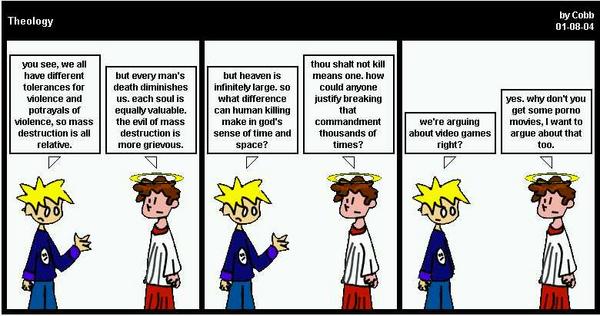
To get a feel of Daniel Chew Huicong’s childhood, we would peruse a cartoon which describes how little “Watchman” would make all his friends a “former friend” in his life. Theology, indeed, is a good academic area for him to satisfy his urge for axe grinding and self-aggrandizement.

Saturday, December 19, 2009

Some Misapplied Verses By ODMers

Read the following posts by The Protestant Pope ... hear ye, hear ye!

Ezekiel 3:17

2 Timothy 3:12

And here's another update by the Protestant Pope himself.

Even more skeletons found in Daniel Chew's closet. Truth will out!

PS: The secret lives of ODM-ers ...

Thursday, November 12, 2009

A Tiny Note On A Narrow Mind


Note: This is a note on this post by Watchman Chew.

My friend Ivar has written an excellent post here regarding religious hypocrites. Ivar makes the excellent points that:

1. Hypocrites want to be honored by men. (Matthew 6:2).

2. Hypocrites love to pray standing in the Synagogues (and I guess Churches), and street corners. (Matthew 6:5)

3. Hypocrites want to boast of their religious duties, and tell others they are fasting (Matthew 6:16)

4. Hypocrites do not admit their own faults, but look for faults in others. (Matthew 7:5)

5. Hypocrites give a tenth, but neglect justice, mercy and faithfulness. (Matthew 23:23)

6. Hypocrites build tombs for the righteous, but denies that they themselves would have taken part in shedding the blood of the prophets. (Matthew 23:29)

7. Hypocrites honor Jesus with their lips, but their hearts are far from Him. (Mark 7:6)

In like manner, we can discern religious hypocrites from the blogosphere by the following characteristics:

(1) Religious hypocrites are desperate for recognition and want honor from Man. For example, they would appoint themselves with many offices (like author, apologist and watchman), and are desperate to be a teacher of others when they should be students of the Word;

(2) They love to pray (and blog) in full view of their followers. For example, they would pray to God for the anathematization of fellow Christians, pray to God to strike them dead and/or to send them to burn in hell forever. They would then be praised for their “discernment” and encouraged to fight the good fight of faith by fellow watch-bloggers;

(3) They love to boast about their religious duties and/or skills (e.g. watching and exposing errors, leading discipleship classes, attending violin lessons, spouting Greek words/grammar for which they have little knowledge of, etc);

(4) They do not admit their own faults, but constantly seek out the faults and errors of others (hence the office of Watchman). They abhor “watcher of watchmen” watching and exposing them, but they love to watch others. They detest advice from others suggesting that they are self-righteous and/or self-deluded;

(5) They might give a tenth of their income as tithe or a tenth of their precious time for blogging, or even a tenth of their time to publish a book so as to make a name for themselves, but neglect justice, mercy and faithfulness. We would neither hear of them visiting the orphans and widows in their afflictions, nor see them giving their lives to the mission fields in third world countries. We might read about them traveling to nice spots for holidays in the name of “mission” though;

(6) They honor Jesus with the lips (and blogs), but their hearts are far away from Him. These hypocrites are self-righteous, ostentatious, and love pre-eminence amongst Man. They are not after God’s heart, but are really craving for men’s admiration.

IMO, Ivar's post has successfully navigated between two extremes in this regard.

On one extreme is the self-righteous, self-deluded, self-perceived infallibility and parochialism of self-appointed “watchmen” and their blogs (e.g. Daniel Chew Huicong) "which litter the Internet like so many sewer pipes choked full with libel, all initially started mainly to defend some false teaching(s) or teacher(s) but which degenerates into the stinks they now are." (quote taken from Daniel Chew's post)

On the other extreme is the broadmindedness of religious syncretism and the likes of it. We hereby thank Daniel Chew for his thoughtful comments, which are perhaps better suited to describe his Watchman blog site. Typical of self-righteous, self-deluded "watchman" sites, the false teacher and watchman Daniel Chew failed to realize that he had likewise castigated all "watcher of watchmen ministries" with his recent post (cf. Daniel's comment on the Christian blogger, Tim Challies). Thanks Ivar for your excellent article.

Thursday, October 15, 2009

Lessons in Logic 101


We can derive precious lessons in informal logic by perusing the illogical statements and “arguments” of the venerable Watchman Daniel Chew Huicong.

As the readers would have known, there is a little debate occurring between Chew and Ming Liang at the Credo 500 website.

While the storm brews and darkness befalls the tiny island of Singapore, the titter of a sniggering Chew could be heard resounding through the corridors of a particular residential estate. As Chew sets out to “tear down” poor little Ming Liang, Chew pompously (and superciliously) announced:

Chew: “However, the Bible and its truth stand over and against your reasoning. I will now deconstruct your entire argument.” [thunder and lightning]

Narrator: I never knew Derrida’s method of “deconstruction” is such illogical child’s play. Derrida must be rolling in his grave. Let us enjoy the fun that follows.

In the ongoing debate over at Credo 500, Chew began his attack by making a bare assertion:

Chew asserts: "God however escapes moral culpability because sin and sinful actions are not directly caused by Him, but are caused by secondary agents under His control." [audience gasped in awe]

Narrator: Here, Chew insists that God “escapes moral culpability because sin and sinful actions are not directly caused by Him.” So, as any logical fellow would, Ming Liang asked for an argument for Daniel’s bare assertion. The burden of proof falls upon him who makes the claim.

So Ming Liang asked: “Why is it so that God “escapes moral culpability” just because evil are (allegedly) not directly caused by Him?”

Narrator: It follows that Chew commits a classic logical fallacy - shifting the burden of proof.

Chew snapped: “Why is it that God does not escape moral culpability just because evil is not directly caused by him?” [audience gasped further]

Narrator: It’s like the following (silly) debate between Tom and Jerry:

Tom: God exists.
Jerry: Prove that He does.
Tom: Prove that He doesn’t.

In conjunction with the above bare assertion (a logical fallacy as well) by Chew, Ming Liang asked, “Is evil (all kinds of evil?) not directly caused by God? What is your argument for this?” This is a reasonable question since Chew asserts that evil is not directly caused by God. Instead of arguing for his point, Chew repeats the same fallacy of shifting the burden of proof.

Chew: “What is your argument for the contrary? How do you know either way?” [more lightning and thunder]

Narrator: But Ming Liang does not need to argue for “the contrary,” as Chew is the one arguing for the proposition that P = “God escapes moral culpability because sin and sinful actions [or evil] are not directly caused by Him.”

As an analogy:

Chew: “You are an idiot.”
Jason: “Why is it that I am an idiot?”
Chew: “Why is it that you are not an idiot?”

Narrator: It’s clear here who truly is the idiot – the one who couldn’t even conjure up a single argument for his proposition that P. P is still a bare assertion. There’s no way a sane, logical fellow can argue with dunderheads like Chew. In like manner, he’ll probably claim that a flying omnipotent earthworm Jim exists, and demands that you prove why a flying omnipotent earthworm Jim doesn’t exist (which is called proving the negative and shifting the burden of proof).

Chew claimed: “I was not trying to explain evil, but to give a viable philosophical explanation of how God can be the ultimate cause but not the author of sin.” [in the tune of Massenet’s Meditation from Thais]

Then Ming Liang asks a very simple question to clarify Daniel’s point, “What kind of evil are you referring to in “I was not trying to explain evil …’”?

Chew answered: “Precisely the point that I am not trying to explain why evil exists. I am only trying to explain how it exists given the axioms of Scripture.” [audience gasp in wonder]

Narrator: Chew doesn’t even seem to understand basic English. Poor Ming Liang asked “what kind of evil [was Daniel] referring to.” It’s really a simple question. But Chew ignored the question, and “argued” for something that wasn’t even asked in the first place, thereby committing the fallacy of ignoratio elenchi or an irrelevant conclusion.

It’s like this scenario:

Chew: “I like ice cream.”
Ming Liang: “What kind of ice cream are you referring to?”
Chew: “Precisely the point that I am not trying to explain why ice cream exists. I am only trying to explain how it exists given the axioms of Scripture.”

Narrator: What do you folks call this kind of debater – mentally challenged?

Ming Liang asked, “You referred to moral evil in “sin and sinful actions.” But does God escape moral culpability for metaphysical evil and physical evil? If so, why?”

Chew replied: “First of, upon what basis is evil defined as "evil". Secondly, why must God be culpable for "metaphysical evil and physical evil"?”

Narrator: Chew’s question (in reply to a question) is really amazing. As a Christian who exhorts sinners to do good and to eschew evil, he doesn’t even know what is the “basis” by which evil is defined! I thought he had the Bible, and I thought he would have at least said that the basis for the definition of evil is the Bible. But lo and behold, how can we trust such a “Christian” man to teach good and evil? He would perhaps even confuse good with evil! Chew’s other question, “Why must God be culpable for "metaphysical evil and physical evil," is merely his attempt to push his bare assertion further – without any argument whatsoever – simply by rephrasing that P. This shifts the burden of proof again, and saves his ignorance by rephrasing a question in the negative.

Chew: “God is not culpable for evil (which includes metaphysical evil and physical evil).”

Jason: “Why is God not culpable for evil (which includes metaphysical evil and physical evil)?”

Chew: “Why must God be culpable for "metaphysical evil and physical evil?"

Narrator: That “logic” and “argument” would surely earn him an honors in the BA in philosophy for chowderheads.

Ming Liang asked: “If God is the ultimate cause of all things, and if all things include evil, God is the ultimate cause of evil. Do you agree/disagree with this? If so, why?”

Narrator: It is clear that the arguments are already stated in the above sentence syllogistically:

P1 = God is the ultimate cause of all things.
P2 = All things include evil.
C = So God is the ultimate cause of evil. (Conclusion)

Instead of challenging the major and/or minor premises, and/or the validity of the syllogism, Chew – who is well versed in [the lack of] logic – answered:

Chew: “No, I disagree. Please elucidate the arguments for saying so.”

Narrator: Excuse me, Mr Chew. The arguments are already “elucidated” in the form of a syllogism in Ming Liang’s question. Chew apparently doesn’t even recognize the most basic of all logical arguments – syllogistic reasoning. I think a mutated monkey would disagree with Ming Liang in almost the same manner as Chew.

Monkey: “No, I disagree. But I don’t recognize your arguments or why I even disagree.”

Ming Liang wrote: “I’m sorry, but I believe you’re trying to convince me with circular reasoning i.e. we know that P (e.g. P=God is Good; God is sovereign etc) because the Bible says so; we know that the Bible is true because God inspired it (and God cannot lie); we know that God inspired the Bible (and God cannot lie) because the Bible says so. Hence, a circulus in probando … yeah right. Your direction of reasoning is illogical.”

Chew answered: “Logic, as Jason as said, is the manner of reasoning. It is nonsensical to say that a "direction of reasoning" is illogical.

Narrator: I guess we can all see why Chew’s reasoning is illogical. See all of the above logical fallacies.

Chew continued: “In fact, talking about circular reasoning, yours is also circular. After all, why it is that your axiom of the rightness of your moral sense is to be trusted?”

Narrator: This is truly an amazingly fatuous question from Chew. Ming Liang hasn’t even mentioned a single “axiom” of “the rightness of [his] moral sense,” and Chew somehow purports to know what Ming Liang believes in!

But don’t we all know how Chew utilizes bare assertions all the time to answer questions or to “argue” with those whom he disagrees with?

Chew said: “Since God hold [sic] all responsible for the actions they themselves do, therefore God cannot be the direct author of evil.”

Ming Liang replied: “The Bible claiming that “God [does] hold all responsible for the actions they themselves do” doesn’t mean that this ought to be the case. What if God shouldn’t have held them responsible i.e. **gasp** the Bible is actually incorrect here, or that your interpretation of the Bible is incorrect here, or there’s a mistake in your version, or … etc (e.g. Calvinists even believe that God actually made some humans unto destruction for His glory, depriving reprobates of effectual and particular grace, and these cannot choose otherwise etc)? The Is-Ought distinction must be clearly argued for, not merely asserted (is-ought fallacy plus bare assertion, yeah right).”

Narrator: Ming Liang tried to reason with Chew that he had committed the is-ought fallacy (which is, of course, another logical fallacy). But Chew replied:

Chew: “Sorry, you do not seem to understand what you [sic] talking about. I argue based upon what IS and OUGHT to be based upon the axiom of Scripture. Unlike you, who only argue based upon what IS.”

Narrator: That is again another amazingly fatuous statement! First of all, we haven’t seen a single argument from Chew; at a minimum, “arguments consist of one or more premises and a conclusion.” What premises, conclusions, and valid logical forms had Chew offered thus far? None. We have only seen bare assertions and logical fallacies all throughout Chew’s replies.

Ming Liang had previously tried to explain that, probably as a non-Christian himself, he didn’t accept Scripture to be divine revelation, and Daniel’s replies thus far had been based upon circular reasoning.

Ming Liang explained: “I’m sorry, but I believe you’re trying to convince me with circular reasoning i.e. we know that P (e.g. P=God is Good; God is sovereign etc) because the Bible says so; we know that the Bible is true because God inspired it (and God cannot lie); we know that God inspired the Bible (and God cannot lie) because the Bible says so. Hence, a circulus in probando.”

Narrator: But Chew here persists in his circular reasoning, and it is viciously circular indeed!

Chew: “I argue based upon what IS and OUGHT to be based upon the axiom of Scripture.”

Narrator: And hence, Chew finds circles coherent within his frame of mind and “logic”. [in the tune of Legrand’s Windmills of the Mind]

Lacking a definite argument for his bare assertion that P (where P = “God escapes moral culpability because sin and sinful actions [or evil] are not directly caused by Him”), Chew repeats the same formula of success – shifting the burden of proof.

Chew wrote: “Since God is sovereign, evil must be under His control. The only way IMO that the two can be put together consistently is that evil is indirectly caused by God.”

Ming Liang replied: “Here you acquiesce that “evil is indirectly caused by God.” GIVEN [emphasis here to emphasize that this is given to you, and not that I agree with you] that God is the indirect cause (and indeed, the ultimate cause) of evil, how would you argue from that fact (?fact) that He is not morally culpable?

Narrator: Here, Ming Liang is simply asking for Daniel Chew to argue his case that P. Notice that Ming Liang thus far is examining Chew’s beliefs via questions; Ming Liang never asserted any proposition.

But Chew predictably replied: “How can you argue that God is morally culpable for sin even if he is the ultimate cause of it? Prove your bare assertion.”

Narrator: Once again, he shifts the burden of proof by rephrasing the question in the negative, and asserts that Ming Liang made a bare assertion. Where is this “bare assertion” by Ming Liang, pray tell?

That would certainly earn Chew a Masters in Philosophy for chowderheads.

A hypocrite in the making

Chew: “As stated earlier, your epistemic direction is wrong. We must start off with the axioms of Scripture, then seek to understand how they logically cohere. We are not to start with our own autonomous human reasoning and question the teachings of Scripture.”

Ming Liang replied: “As stated earlier, your epistemic direction is wrong. We mustn’t start off with circular reasoning, and then seek to understand how “circles” logically cohere. We should not be afraid to use reason and logic. Isn’t it hypocritical if we must first use reason and logic to understand or to interpret scripture (how else would you understand scripture or derive these “axioms”?), then turn around and say that we should start from scripture, and not from “autonomous human reasoning”?”

Narrator: Ming Liang here tried to explain that, since Chew had started with “autonomous human reasoning” and logic in order to understand the writings, axioms and propositions of Scripture, it is really hypocritical to alleged that “we are not to start with our own autonomous human reasoning …”.

But apparently, Chew failed to see that fact.

Chew replied: “And of course, your own circular reasoning is off-topic for discussion, I presume. Aren't you doing the same, except instead of Scripture, you substitute your own moral sense?”

Narrator: My point is – what “circular reasoning” had Ming Liang committed thus far? None. But desperate times call for desperate measures. Chew had no choice, but to “save face” by making up allegations against his opponents. Or was he hallucinating or hearing voices in his head?

More importantly, Chew commits a classic tu quoque fallacy. Instead of defending himself from Ming Liang's allegation (of Chew's circular reasoning from Scripture), he accuses Ming Liang of the same. Worse, Ming Liang really did not commit the fallacy of circulus in probando.

Chew closes off the discussion with a classic ad hominem fallacy – poisoning the well.

Chew: “Yea, right. Tell him (or is it you) to make more sense, instead of talking rubbish. And btw, don't expect to go to AT's slanderous and blasphemous site.” [background music: Psycho]

Narrator: Is Antithesis’ blog really slanderous and blasphemous? Please check out the facts for yourselves, dear readers.

The truth hurts, doesn’t it?

When Chew has no arguments for his bare assertions, he commits logical fallacies one after another in order to appear erudite and scholarly.

Well, at least he deserves a Masters in Philosophy.

For chowderheads, that is.

Monday, September 28, 2009

The Art of Christian Necromancy


We now continue our exciting journey into scholarly Chew’s intensely researched article on Rick Warren. We have previously seen that, in his rebuttal of a fellow Christian blogger named Dave Chong, Chew alleged that Chong confused “Classical Arminianism with Evangelical Arminianism.” In a recent comment in the Credo500 Christian Conference, he changed his mind and accused Chong of refusing “to differentiate Evangelical Arminianism from the semi-Pelagian Finneyist theology [of Rick Warren]…”

So which is it, Watchman Chew? Did your brother-in-Christ Dave Chong fail to differentiate between Evangelical Arminianism and Semi-Pelagianism, or did he fail to distinguish between Evangelical Arminianism and Classical Arminianism? Or is it something else altogether?

Or perhaps it is you who are confused?

It seems that Mr Chew is truly confused concerning what Chong is allegedly confused about.

Error 3 – Theological Confusion

We have previously seen that our Watchman Chew had made serious factual errors concerning Arminianism; for example, while the Remonstrants did affirm total depravity, Mr Chew denied that they did.

This time, he revealed that he is actually quite confused with Rick Warren’s theology (doctrinal beliefs).

In a recent comment on Credo500, Mr Chew snarled at Dave Chong:

“Dave:

As usual, you still do not get it. Warren is NOT in any shape the same as Wesley. In fact, Wesley himself would denounce Warren as teaching error. Your refusal to differentiate Evangelical Arminianism from the semi-Pelagian Finneyist theology that Warren teaches is extremely regrettable.” [emphasis mine]

In this comment, the venerable Watchman Chew made it clear that Warren’s theology (doctrinal beliefs) is that of Semi-Pelagianism, calling Warren a “semi-Pelagian Finneyist” in theology. A budding theologian would surely know that Semi-Pelagianism is distinct from Arminianism.[1] Or so we thought.

In Mr Chew’s paper, Evaluating the Purpose Driven Paradigm: Recapturing the Vision of the Centrality of the Gospel, Chew stated clearly that Warren’s theology or doctrinal stand is that of Arminianism. Chew wrote:

“Lastly, the sufficiency of Scripture and of the Gospel is undermined by practical Pelagianism or the embrace of the Finneyist error of revivalism. That the Purpose Driven paradigm is practically Pelagian in its outworking, though doctrinally Arminian, can be seen in its consistency with Finneyist dogma that revival is a natural event engineered by the correct use of natural means.”[2]

Do note that although Chew accused Warren of “practical Pelagianism” (Warren’s praxis), he is adamant that Warren is “doctrinally Arminian” (Warren’s theology).

Here we get a serious problem. In Chew’s ‘expert’ theological discourses on Credo 500, Chew is confident that Warren’s doctrine is that of “semi-Pelagian Finneyist theology.” In other words, he believed that Warren was a Semi-Pelagian in doctrine/theology (not merely praxis). But in his scholarly paper, Chew alleged that Warren is “doctrinally Arminian.”

Hence, after intensive research, Chew is nonetheless confused concerning Rick Warren’s theological or doctrinal system. In one place, Chew was adamant that Warren’s theology is Semi-Pelagianism; in another, Chew was unrelenting in his allegation that Warren’s theology is Arminianism.

So which is it, Mr Daniel Chew Huicong? Is Rick Warren’s theological/doctrinal system that of Semi-Pelagianism or Arminianism?

Error 4 – Ipse-dixitism

We recall that in a recent comment on Credo 500, the venerable Watchman Chew made the following assertion:

“Warren is NOT in any shape the same as Wesley. In fact, Wesley himself would denounce Warren as teaching error.” [emphasis mine]

Giving Mr Chew the benefit of doubt that it is indeed true that Warren is not “in any shape the same as Wesley” – although we are not sure if Chew was referring to Warren’s physique, body-mass index, hairline or theological beliefs – it is puzzling to read how Chew managed to know (for a fact) what Wesley would do to Warren i.e. “Wesley himself would denounce Warren as teaching error.”

That is an amazing statement, spoken with perhaps equally amazing confidence and gusto.

It is possible that Mr Chew had learned the satanic art of necromancy, summoned Wesley from the grave and demanded from him a conclusive denouncement of Warren’s teaching. But this is quite improbable, given that he is a Christian, and that his genealogy does not include the witch of Endor and/or the likes of her.

It is, however, more probable that Mr Chew is entrenched within the minefield of ipse-dixitism; he has learnt the art of spewing ipse dixits and bare assertions – out of his own free will, of course – in order to accuse a fellow Christian blogger of being “confused,” as well as to relegate Warren to that proverbial heretic’s stake.

Still, we would like to hear from Chew: How did he know, for certain, that Wesley would denounce Warren’s teachings as error?

He is no necromancer, ain’t he?

Reference:

[1] “Both Semi-Pelagianism and Arminianism insist upon a synergistic view of redemption. A person’s salvation is the result of two agencies: (1) God’s grace and (2) human faith and obedience. But here again, there are important dissimilarities. The Semi-Pelagians thought of salvation as beginning with human beings. We must first seek God; and his grace is a response to that seeking. The Arminians of the seventeenth century, however, held that the human will has been so corrupted by sin that a person cannot seek grace without the enablement of grace. They therefore affirmed the necessity and priority of grace in redemption. Grace must go before a person’s response to the gospel. This suggests that Arminianism is closer to Semi-Augustinianism than it is to Semi-Pelagianism or Pelagianism. The word Pelagian as a description of Arminians – or Roman Catholics for that matter – does them an injustice because it associates them with a theological tradition that is truly heretical in that Pelagius trivialized grace, and in so doing trivialized the work of Christ.” Robert A. Peterson and Michael D. Willams, Why I Am Not an Arminian (Downers Grove, IL: InterVarsity Press, 2004), 39-40.

[2] Daniel Chew Huicong, Evaluating the Purpose Driven Paradigm: Recapturing the Vision of the Centrality of the Gospel, 22nd Sep 2009, p.9

Saturday, September 26, 2009

Empty vessels make the most noise


Scholarly Chew had apparently done intensive research on Arminianism (both classical/historic/reformation and Wesleyan) and Calvinism in the process of writing both “his book” and the recent article published in the Credo500 ecumenical Christian conference.

It is hopeful that he had gone through tomes of good books, articles, journals and references in his quest for the truth. We would then expect – at least on widely read, public Christian theological conferences – that our scholarly Daniel Chew Huicong would have got his basic facts correct.

We would expect – at the very least – basic research with Wikipedia and minimal knowledge on key aspects of Arminianism (both classical/historic/reformation and Wesleyan) before proceeding in his critique of, repudiation of, and condemnation of an alleged Arminian i.e. Rick Warren to the esteemed status of “heretic.”

But lo and behold, our scholarly and well read Daniel Chew Huicong has alas failed to grasp a Wikipedia-level of knowledge that perhaps even prepubescents will be able to understand and appreciate.

In his recent rebuke of a fellow Christian blogger (Dave Chong), Daniel snapped,

“You are confusing Classical Arminianism with Evangelical Arminianism. The Arminianism of the Wesleys is different from the Arminianism of the Remonstrants. For example, Wesley affirmed Total Depravity, while the Remonstrants did not.”

Is it true that blogger Dave Chong is confused, or is our scholarly Chew discombobulated?

Error 1

Watchman Chew wrote, “… Wesley affirmed Total Depravity, while the Remonstrants did not.”

Really?

Basic research on Wikipedia would have resolved his bewilderment, but alas, well-researched Chew couldn’t do better than our familiar Wikipedia.

Wikipedia says, “Classical Arminianism (sometimes titled Reformed Arminianism or Reformation Arminianism) is the theological system that was presented by Jacobus Arminius and maintained by the Remonstrants … [In this system of Arminianism] Depravity is total: Arminius states "In this [fallen] state, the free will of man towards the true good is not only wounded, infirm, bent, and weakened; but it is also imprisoned, destroyed, and lost. And its powers are not only debilitated and useless unless they be assisted by grace, but it has no powers whatever except such as are excited by Divine grace.’”

You see, Article 3 of the Remonstrants really affirmed “total depravity” [but with a disclaimer; see below] while explaining away its effects through Arminius' doctrine of prevenient grace. If the Remonstrants denied total depravity outright, they would have little need for a doctrine of prevenient grace [1].

A quick research on the WWW would reveal further relevant material for his rebuke of fellow Christian blogger Dave Chong:

Quote – “The Five Articles of Remonstrance contrast with the Five Points of Calvinism on four points and agree on one point (namely, total depravity).”

Quote – “Article 3 [of Remonstrants]. Deprivation - corresponds to the first of TULIP’s five points, Total Depravity.”

It’s really very easy reading. There’s no need for tomes and journals for such simple, rudimentary knowledge on theology. And a little research into commercially available books would reveal clearly that Arminius and the Remonstrants did teach total depravity.[2]

Error 2

Watchman Chew said, “… Wesley affirmed Total Depravity …”

Theologians would attempt to distinguish between a Calvinist’s “Total Depravity” and a Wesleyan’s “Total Depravity.” After all, theology is also about fine concepts and distinctions. But Scholarly Chew falls victim to a common fallacy, the fallacy of equivocation, albeit unintentionally.

What kind of “total depravity” was he referring to? Wesley’s “total depravity” is different from Calvin’s; for example, Theopedia explains, “As John Wesley stated more forcefully, humans were in fact totally corrupted by original sin, but God's prevenient grace allowed free will to operate. Universal prevenient grace is the "hair's breadth" that separates Wesley from the Calvinist view of total depravity.”[3]

Wesley scholar Kenneth J. Collins correctly contrasts Wesley’s teaching with that of Calvin.

“At least initially, there does appear to be great similarity between Wesley’s doctrine of original sin and that of … Calvin, especially in the emphasis on total depravity. Upon closer examination, however, there are important differences to be noted largely due to different conceptions of grace. For instance, when Wesley uses the vocabulary of total depravity, he is referring to what he calls, “the natural man,” that is, to a person who is utterly without the grace of God. But does such a person actually exist? Not according to Wesley, for in the sermon “On Working Out Our Own Salvation” (1785) he states: “For allowing that all souls of men are dead in sin by nature, this excuses none, seeing that there is no man that is in a state of mere nature; there is no man, unless he has quenched the Spirit, that is wholly void of the grace of God. No man living is entirely destitute of what is vulgarly called ‘natural conscience.’ But this is not natural; it is more properly termed ‘preventing grace.’” [4]

So according to Calvin, inability is the condition of actual human beings, and grace, therefore, must be irresistible if anyone is to be saved.

In conclusion, we would therefore appreciate at least a Wikipedia-level of research prior to subjecting a fellow Christian (i.e. Rick Warren) to the charge of heresy. Furthermore, we would truly appreciate if scholarly Chew would meditate upon a common English idiom, “Empty vessels make the most noise.”

Basic Reference:

[1] “Prevenient Grace” is a term that was used in the Remonstrance, a seventeenth-century document formulated by Jacobus Arminius and others, to protest the Calvinistic soteriology of the Reformers. The term itself simply means “grace that comes before”; but the Remonstrance cast it in terms of the grace of God given to all mankind without exception, which enables all men to respond to God's invitation and believe in the gospel. (see http://www.monergism.com/thethreshold/articles/onsite/qna/prevenient.html)

[2]“[Arminius] declared that “nothing can be spoken more truly concerning man in this state, than that he is altogether dead in sin.” Later Arminians, including John Wesley and the main Methodist Arminian theologians of the nineteeth century, agreed completely with Arminius [on total depravity].” Roger E. Olson, Arminian Theology: Myths and Realities (Downers Grove, IL: InterVarsity Press, 2006), 56-57, quoting Arminius, “Public Disputations,” Works, 2:194. Olsen continued, “Arminians together with Calvinists affirm total depravity because of the fall of humanity in Adam and its inherited consequence of a corrupted nature in bondage to sin. … Arminius’s own account of human fallenness could hardly be stronger if he had been a full-blown Calvinist!” Olson, Arminian Theology, 55-56.

[3]It was also Wesley who “claimed that his own theology was “within a hair’s breadth” of Calvin’s teachings.” Olson, Arminian Theology, 55.

[4] Kenneth J. Collins, Scripture Way of Salvation, pp. 38-39, quoting Wesley, “On Working Out Our Own Salvation,” in The Works of John Wesley, ed. Albert C. Outler (Oxford: Clarendon, 1975-1983), 3:207.

Friday, September 25, 2009

See My BOOK!


Before we study and meditate upon the Watchman Chew’s scholarly paper in the Credo500 conference, we should take heed to Chew’s dogged insistence [in his paper] for his readers to “see [his] book.” Even as you peruse his paper on Rick Warren’s “heresy” and “false gospel,” you would observe a reiterating phrase, “see my book.”

Therefore, as instructed by our venerable Watchman, we decided to “see [his] book.” Of course, we are not furnished with a copy of “his book” – the book – so we could only peruse “the book” as reviewed by Amazon.com for now. If we are convinced to purchase a copy of “the book,” then we might just invest our hard-earned money into a copy of “his book”.

This book – the book – is Driven Away by Purpose: An Analysis of The Purpose Driven Life and Related Issues, 2 Ed. (Xulon Press, 2006) by Daniel HC Chew.

On Xulon Press’ website, which is the publisher’s website, we would find a brief description of “his book.”

DANIEL CHEW is an informed Christian layman who has experienced first hand the consequences that came with the advent of compromise which culminated in the Purpose Driven Movement. As a watchman called by the Lord, he endeavors to warn the Church against the compromise and wrong teaching that infiltrates and threatens to engulf her. Daniel is currently finishing his undergraduate studies in the National University of Singapore (NUS), Singapore for a BSc. (Honors) degree. He lives with his parents and one younger brother in their home country of Singapore.

There are a couple of things we can glean from the above information.

Firstly, Xulon Press is a POD or Print-On-Demand publisher. In the past, an author would have to submit his book to a publisher, who would then review the book and subsequently decide if the book is fit for publishing. Not with a POD author. With most POD companies, an author who has the funds can have his book published anytime, irrespective of quality of writing, editing, or information content. His book does not need to be reviewed for quality, editing, scholarship, or information content.

Deborah Ng observes that, “Because there's no major risk, as there is with traditional publishers who have to order large print runs, almost anyone can be a published author [with POD]. … If you've always dreamed of being published and you're unable to go the traditional route, you might consider a print on demand publisher. … In the past, if an author was rejected by a publishing company, she wouldn't be published. Now she can be – with print on demand.”

In other words, like the Watchman Chew (whose name card says “author”), all my children, nephews, nieces, and perhaps a monkey who can type would all qualify to be authors. Besides, they can all have name cards that say “author.”

Secondly, even in his book description, the Watchman Chew affirms that he is “a watchman called by the Lord.” He really does think that he is a “watchman” called by the Lord (and of course, the word “watchman” appears on his name card as well).

Thirdly, how would a BSc. (Honors) qualify him to write a theological critique of Rick Warren? This is possibly the reason why his book wasn’t submitted to a commercial publisher or reviewed by a theological committee.

Fourthly, why should we “see [his] book” if his academic and/or theological qualifications are as good as any BSc (Honors) graduates we find on the streets? That is in itself an argumentum ad verecundiam – an appeal to false authority. Is “his book” an appropriate authority in theology and/or Rick Warren’s teachings?

Finally, we would peruse a review from a Dan Proctor or Pastor Dan. We don’t know who pastor Dan is. Neither do we think that he is an authority in theology and/or Rick Warren, not unless he proves it for us. Nevertheless, we are presenting his review of Watchman Chew’s book as an interesting interlude in this post.

Pastor Dan wrote,

I ordered this book believing it would be an analysis of the purpose driven life movement, which I also oppose. What a disappointment to learn right away that the author is a Calvinist and like many, he is absolutely consumed with its false theology and warped concept of God. The book becomes nothing more than a forum to lecture us on the rightness of Calvinism as opposed to Arminianism.

The author makes a statement that demonstrates the piousness of many Calvinist authors. He says that "you are either a Calvinist, an Arminian, or a confused person." How insulting! In other words, you have to either bow down to the allegorical mysticism of Calvinism or the deluded system of Arminianism or you are a confused person. I'm not confused at all! I am a Bible belieiving dispensationalist who understands how to rightly divide God's Word in light of Paul's distinct apostleship and message.

The book is overpriced for what you get. The author tends to repeat himself over and over again as if we didn't get his point the first time. It is quite obnoxious. It seems that his main purpose is not to expose the false doctrine and philosophy of Rick Warren. It is to prove that Rick Warren is an Arminian. Like anybody besides another Calvinist cares!

The author looks like he is about 16 years old on the back cover and is definitely not an accomplished writer. There are typos and the book comes across as very amateur.

If you want a thorough analysis of PDL movement and Rick Warren, forget this book and get “Who's Driving the Purpose Driven Church?”


We can’t blame Dan for thinking that the Watchman is 16 years old.

Some other comments follow:

N8 writes,

I have been blogging with Him for the last few weeks on http://astronova.multiply.com/video/item/16/Joseph_Prince_the_heretic

He is doing the same thing to Joseph Prince.

When people react his warped theology he says they "need to use scripture". When people use the scriptures, he says they "have bad Theology"! And when people use Logic he deletes their comments.

I have not read the book and have no intention to do so.

Thanks for the review.

M. Aubrey (Linguist) writes,

No offense, but that's what you get from buying a book from a guy whose only 26 and already thinks he's got the whole world figured out.

So should we “see [his] book?”

I don’t know, but we’re still trying to get our hands on a copy of it, perhaps for free from our contacts. A photocopy would be very fine for our purpose though.