Showing posts with label Art of Watching. Show all posts

Thursday, April 29, 2010

Watchman Chew "Watching" His Classmates In School


PS: Click on comic to view full cartoon!
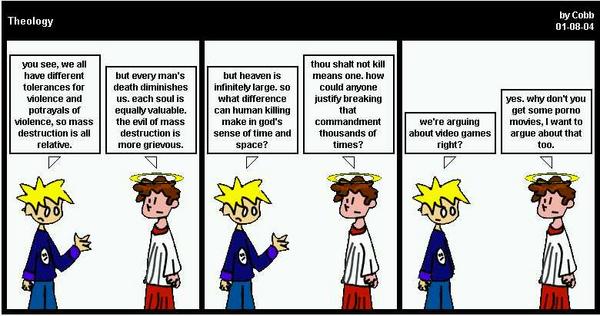
To get a feel of Daniel Chew Huicong’s childhood, we would peruse a cartoon which describes how little “Watchman” would make all his friends a “former friend” in his life. Theology, indeed, is a good academic area for him to satisfy his urge for axe grinding and self-aggrandizement.

Thursday, November 12, 2009

A Tiny Note On A Narrow Mind


Note: This is a note on this post by Watchman Chew.

My friend Ivar has written an excellent post here regarding religious hypocrites. Ivar makes the excellent points that:

1. Hypocrites want to be honored by men. (Matthew 6:2).

2. Hypocrites love to pray standing in the Synagogues (and I guess Churches), and street corners. (Matthew 6:5)

3. Hypocrites want to boast of their religious duties, and tell others they are fasting (Matthew 6:16)

4. Hypocrites do not admit their own faults, but look for faults in others. (Matthew 7:5)

5. Hypocrites give a tenth, but neglect justice, mercy and faithfulness. (Matthew 23:23)

6. Hypocrites build tombs for the righteous, but denies that they themselves would have taken part in shedding the blood of the prophets. (Matthew 23:29)

7. Hypocrites honor Jesus with their lips, but their hearts are far from Him. (Mark 7:6)

In like manner, we can discern religious hypocrites from the blogosphere by the following characteristics:

(1) Religious hypocrites are desperate for recognition and want honor from Man. For example, they would appoint themselves with many offices (like author, apologist and watchman), and are desperate to be a teacher of others when they should be students of the Word;

(2) They love to pray (and blog) in full view of their followers. For example, they would pray to God for the anathematization of fellow Christians, pray to God to strike them dead and/or to send them to burn in hell forever. They would then be praised for their “discernment” and encouraged to fight the good fight of faith by fellow watch-bloggers;

(3) They love to boast about their religious duties and/or skills (e.g. watching and exposing errors, leading discipleship classes, attending violin lessons, spouting Greek words/grammar for which they have little knowledge of, etc);

(4) They do not admit their own faults, but constantly seek out the faults and errors of others (hence the office of Watchman). They abhor “watcher of watchmen” watching and exposing them, but they love to watch others. They detest advice from others suggesting that they are self-righteous and/or self-deluded;

(5) They might give a tenth of their income as tithe or a tenth of their precious time for blogging, or even a tenth of their time to publish a book so as to make a name for themselves, but neglect justice, mercy and faithfulness. We would neither hear of them visiting the orphans and widows in their afflictions, nor see them giving their lives to the mission fields in third world countries. We might read about them traveling to nice spots for holidays in the name of “mission” though;

(6) They honor Jesus with the lips (and blogs), but their hearts are far away from Him. These hypocrites are self-righteous, ostentatious, and love pre-eminence amongst Man. They are not after God’s heart, but are really craving for men’s admiration.

IMO, Ivar's post has successfully navigated between two extremes in this regard.

On one extreme is the self-righteous, self-deluded, self-perceived infallibility and parochialism of self-appointed “watchmen” and their blogs (e.g. Daniel Chew Huicong) "which litter the Internet like so many sewer pipes choked full with libel, all initially started mainly to defend some false teaching(s) or teacher(s) but which degenerates into the stinks they now are." (quote taken from Daniel Chew's post)

On the other extreme is the broadmindedness of religious syncretism and the likes of it. We hereby thank Daniel Chew for his thoughtful comments, which are perhaps better suited to describe his Watchman blog site. Typical of self-righteous, self-deluded "watchman" sites, the false teacher and watchman Daniel Chew failed to realize that he had likewise castigated all "watcher of watchmen ministries" with his recent post (cf. Daniel's comment on the Christian blogger, Tim Challies). Thanks Ivar for your excellent article.

Monday, October 20, 2008

Watchman Chew Is Watching You!

I came across this hilarious post when I was enjoying the Puritan-Reformed fellow’s antics on his blog. (Update: Watchman Chew has since deleted his previous post, but he seems to have forgotten that the post is replicated in his personal blog diary here. Enjoy it before he deletes the evidence AGAIN!)

It seems that he has an official name-card.

He is not a pastor, elder, deacon, bishop, archbishop, or the pope (I think you would have guessed).

But he has an important office in the Church of our Lord Jesus Christ.

This office puts him above all other offices. And his responsibilities are great and grievous.

No, he is not just a pastor.

No, he is not just the pope.

He watches over all pastors, elders, deacons, bishops, archbishops, and the pope himself.

Daniel Chew is the Watchman. More specifically, Watchman Chew.

A commentator on the post of his (by the handle of “MarkBark”) wrote:

Dear Watchman Chew (author AND apologist as well),

Your humble commentator here acknowledges your spiritual authority in pronouncing oracles against those whom you deem as heretics and deviants-in-Christ.

Watchman Chew (can I call you WC for short?), yours is a position of great responsibilities. As the uncle of Spiderman (in Spiderman fame) has said, "with great talents come great responsibilities."

So, WC, may you be encouraged as a Watchman to watch over and guard the universal church of God against deviant pastors, elders, bishops, and archbishops from every denomination, church and diocese on this planet.

What an awesome responsibility, WC!

yours-in-agreement,
Watchman of Watchmen,
Mark B.

In response, Watchman Chew (the most reverend, most high) pronounced a warning (ex-cathedra) to our friend MarkBark:

“I exhort you to repent of your pride and turn to God in humility for forgiveness of sins, otherwise I can tell you that you will face the wrath of God when Christ comes again, and contrary to what some may believe, it is NOT a pleasant thing. While you still have time, and while it is today, repent of your prideful attitude, name-calling and rebellion against God (Heb. 3:7-11), and do not spurn the kindness of God towards you.”

Oh, hide us from the wrath of Watchman Chew!

Oh, thou art most holy, Watchman Chew!

Oh, thou wouldst grant us mercy, thou most reverend Watchman Chew!


On retrospection, I have realized something concerning watchmen.

Watchmen like to watch over everybody else, but they abhor anyone watching them.

Watchmen watch over even the writings and pronouncements of the Pope, but he himself is above all such “watching.”

In other words, these watchmen put themselves above the Pope in terms of spiritual authority and office.

They watch over the pastors, elders, deacons, bishops, archbishops, and the pope himself, but nobody is supposed to watch over the watchmen.

Best of all, watchmen are self-appointed.

They are appointed by their conceited, narcissistic, vainglorious pride. And who are we to disagree?

But I have given myself a dreadful responsibility.

I would be watching over these watchmen, including the most reverend Watchman Chew.
Thursday, October 16, 2008

I Want To Be A Real [Boy] Scholar, But I Can’t Stop Lying!


Some Christians Need To Learn Basic Honesty In Debates

The latest comment from Joel at the Puritan-Reformed fellow’s blog reeks of lies and deceit. That is one reason why I could not be bothered to engage him. If he could not brush-up his honesty and integrity when confronting his opponents, I doubt he would be prepared for any serious research.

He wrote:

Antithesis was not arguing from a Van Tillian view but from a Neo-orthodox position. Secondly, the language used is not consistent with Christian behaviour. Third, he is not very familiar with some of the modern Van Tillian writers when he said that modern apologists in the Van Tillian school do not use the argument from "impossibility of the contrary". (TAG argument)

I take issue with his second and third point.

He made the bare assertion that my language is not consistent with Christian behavior. What slander. Readers can read all that transpired between the both of us. It appears that anybody who is not a Clarkian would be labeled as either a heretic by Daniel Chew, or be slandered by his bulldog – Joel – as being unchristian.

He also asserted that, “[I am] not very familiar with some of the modern Van Tillian writers when he said that modern apologists in the Van Tillian school do not use the argument from "impossibility of the contrary". (TAG argument)”

Again, this young man is simply ignorant. I had already answered him in this post.

I wrote,

“The conceptualist’s argument for the existence of God (as described by atheist Quentin Smith) has much potential in the realm of dealing with atheologians; unfortunately, the tag (pun intended) of “transcendental argument for God” has been following this valid argument. By the way, Gordon Clark used the ontology of truth to develop an interesting “transcendental argument” in “A Christian View of Men and Things.” The late Ron Nash, a Christian philosopher heavily influenced by Clark, defends it in his lectures on Christian apologetics. Again, I’m certain you would have known this.”

[Joel] wrote, “I’m referring to Van Til’s argument which "argues from the impossibility of the contrary”. This is a basic mistake in Logic, as the video link in my earlier comments indicate. We should be arguing from the impossibility of the contradictory – not contrary.”

I further replied, "Er … the conceptualist’s argument is similar to the TAG you are reiterating here. Try googling for “conceptualist’s argument Quentin Smith?” But I’m sure you would have done this."

He obviously didn't do this.

My point is, both Van Til and Clark used the TAG. By the way, if you would research into this a little more, the TAG is logically valid (which points us back to my previous question – what qualifies as a “proof” for you?). There’s more to Aristotelian logic than this; Google is a useful tool.

I finally added:

Oh yes, before I forget – no contemporary philosopher who uses the TAG or the conceptualist argument "argues from the impossibility of the contrary”. Copi’s text (shown in that “enlightening” Youtube video) is for first year students; the folks I know don’t make that mistake. And surely if you would pick up a paper on this, you would find more than the square of opposition.

See my exact wording? I was referring to contemporary philosophers, not “modern apologists in the Van Tillian school.” Apparently Joel couldn’t conjure up sufficient honesty when he is out of rational arguments against me. And it is clear that he has no clue which philosopher(s) I’m referring to. (I hope he worked out what the "square of opposition" is.)

What is so amazingly ignorant of this chap is this: in philosophical journals, philosophers of religion use the conceptualist argument, which is a development of the TAG. The conceptualist argument does NOT argue from "impossibility of the contrary." And that is what I was pointing out to him in good spirit (read my original comment).

What's more, his idol – Gordon Clark – uses the TAG as well! So what is his problem? Why doesn’t he criticize Clark's TAG? Anyone smell the stench of hypocrisy here?

Lastly, my “neo-orthodox” label was given to me by the Puritan-Reformed fellow. So why can’t I use that label?

Friday, October 10, 2008

Clarkians Lie Just To Look Good


This is a roundup of the discussion with PuritanReformed and his bulldog.

The PuritanReformed guy had just written a post to distort and lie about the discussion we had. If you want the exact words used in this debate, read the original comments at my blog. I had saved every word he wrote on his blog.

PuritanReformed claims,

"If p refers to the ability of language to communicate perfectly, and q refers to the actual empirical fact of language being largely able to communicate truth perfectly, then the propositions "If p, then q" is most definitely true."

Considering one who claims to know basic logic, it is embarrassing to even expose such a self-deluded fellow such as he.

“If P, then Q” is sound only if the premises are true. Know the difference between “valid” and “sound?” An argument may be valid, BUT UNSOUND.

Let’s examine the premises.

PR claims, “If p refers to the ability of language to communicate perfectly,” then it follows that q = “the actual empirical fact of language being largely able to communicate truth perfectly.”

Q is a bare assertion; and if P then Q is a non-sequitur.

Since when do we observe that language is “largely able to communicate truth perfectly?” Where is that “empirical” or scientific proof or evidence? PR must be sitting in his room totally unaware of what is going on in linguistics, philosophy or even real life. P is overtly false.

Notice he used the term, “true” in his own words, "If p, then q" is most definitely true.” Syllogistic reasoning can only be valid/invalid and/or sound/unsound. He doesn’t even know this basic fact.

His claim that we commit the mistake of "If ~p, therefore ~q" or also known as denying the antecedent is therefore a straw man. His conditional, "If P then Q," is not even sound in the first place, and he doesn't even know that.

We insist therefore, "~q, therefore ~p," which is definitely valid.

But there's more!

His reasoning is actually fatally flawed, and he has no clue why. Let me explain.

Not only “if P then Q” is unsound, it is also circular when we consider the primary premises P and Q.

PuritanReformed claims, “If p refers to the ability of language to communicate perfectly,” then it follows that q = “the actual empirical fact of language being largely able to communicate truth perfectly.”

But Q (the consequent) already assumes as a matter of fact that language is “largely able to communicate truth perfectly,” which is exactly what we are investigating (i.e. the ability of language to communicate perfectly), thereby begging the question and making his conditional statement circular in reasoning. “Largely able to” refers to “ability to,” and this is rephrased as "ability of" and inserted into P as the antecedent.

How circular in his thinking can one gets?

Further Points of Note

1) PR asked the question, “Question: In your opinion, is there ONE meaning for any particular sentence made by anyone?”

He then concluded, “Antithesis totally misunderstand the question that I was asking, which was about a particular statement; a single statement, NOT two similar statements used in two different contexts.”

See how he twists the original question into another one – the fallacy of redefinition? (which only serves to emphasize the ambiguity of language)

He asked if there is only ONE meaning to a particular sentence.

I gave him one sentence – which is made up of only one word, “Great!” – and put that sentence in two different context.

Instead of honestly saying that the two sentences were the SAME – with EXACTLY the SAME word – he used the word “similar.” Now “same” and “similar” are used very differently in theology and philosophy.

You may have similar eyes to your dad’s, but they are not the same as your dad’s eyes.

Secondly, I didn’t misunderstand his silly reasoning. The example I gave is as follows:

Let’s consider the sentence, “Great!” in different contexts.

A boy got his exam results, and it is an A. He said, “Great!”

A boy got his trousers torn by his school bullies. He said, “Great!”

Do those two sentences - “Great!” - mean the same thing? But according to you, they both mean the same thing. One meaning, right?

My example must be understood in the context of PR’s previous statement. PuritanReformed said,

“Language is used by individuals. If individuals do not use the words with their official meaning(s), then that sentence made would be unable to express truth perfectly because that person misuses words. That is all I mean by that.”

Since he made the fatuous statement that words have “official meaning[s],” I did a reductio ad absurdum on him:

I asked, “Ah, for the word “Church,” what is the “official” meaning? Most dictionaries would furnish more than 10 different meanings. So which is “official?’”

2) So in the context of our previous discussion on the “official” meaning of words – which PR had no reply thus far – I gave him the example of two sentences having exactly the same word used in two different contexts.

I had asked him the “official” meaning of the word “Church.”

PR said, “So? The meaning of a word as used in CONTEXT is only one, not the meaning of a word divorced from any context.”

I replied,

“But you haven’t answered my question. You claim that there is an OFFICIAL meaning for every word. Which is it for the word “church?”

Furthermore, even if you claim that context helps to interpret the meaning of each word, CONTEXT NEEDS INTERPRETATION AS WELL. So how do you interpret the context IN WHICH A PARTICULAR WORD APPEARS? Remember that “context” in language is ALSO MADE UP OF WORDS.

So which is the “official” meaning of a particular context? Infinite regress here?”


PR doesn’t seem to realize that, besides committing logical fallacies, he doesn’t even understand what these fallacies are all about. It is evident that he has no clue because he doesn’t address them AT ALL in his subsequent replies.

a) Firstly, PR claims that there is an official meaning for every word in language (see his words above), but is unable to give me THE OFFICIAL meaning for the word “Church.”

b) Secondly, he claims that context – which is likewise made up of words in the form of subject/predicate/complex predicate – decides what “official” meaning to use. But isn’t this infinite regress? So which “official” meaning of the context (which is made up of words) should we use to interpret the “official” meaning of the word “church?”

c) Thirdly, he begs the question when he wrote, “If individuals do not use the words with their official meaning(s), then that sentence made would be unable to express truth perfectly because that person misuses words.”

He claims that there is an official meaning for every word used.

But which “official meaning” of the word “official” should we use when we define his terminology of “official meaning of a word?” Obviously, he takes “the official meaning” to be numerous meanings, depending upon the context in which the word appears. So, is the "official meaning" of a word ALL the dictionary/lexical definitions for a particular word? And yet PR insists that language communicates truths perfectly and is unambiguous.

This just reinforced my point that language is ambiguous at times, which PR vehemently denied. I am not denying that language does communicate truths; it just doesn't do so perfectly at times. That is why we have so many different interpretations of Scripture.

3) PR claimed, “This failure to distinguish between sentences/phrases and propositions is a very fundamental error in logical argumentation — one which is covered in basic logic class within the first few weeks, and therefore it should not be made by those who have studied logic in any degree whatsoever.”

Going back to my example of the two sentences with exactly the SAME word.

Let’s consider the sentence, “Great!” in two different contexts.

A boy got his exam results, and it is an A. He said, “Great!”

A boy got his trousers torn by his school bullies. He said, “Great!”


PR just proved my point. Two SAME sentence with EXACTLY the SAME words, but conveying two different PROPOSITIONS.

PR seems to understand this when he wrote:

1st boy: Great = I am happy to have accomplish this feat (of scoring an A)

2nd boy: Great = A terrible thing has happened to me (trousers torn by school bullies) (and I am being sarcastic about it)


SAME word in two SAME sentences, two different propositions expressed by the SAME word. What more do we need?

He has just (fatuously) proved my point that language cannot convey meaning perfectly, and is sometimes open to misinterpretation and ambiguity. But he STILL denies that language is ambiguous.

4) PR also claimed (to save his dignity?) that I had missed his reductio ad absurdum. But he didn’t seem to get that I was using a reductio on his reductio, a play on rhetoric.

5) We talked about textual criticism where I showed him that he didn’t have the words of the original autographs. He put on an air of knowledge concerning “critical texts,” but to our amazement, he doesn’t even KNOW what is a “critical text!”

6) Lastly, in my previous post, I asked him numerous questions which he cannot answer. He thinks that simple ad hominem and ignoratio elenchi can redirect the argument somewhere. I said:

You – PuritanReformed – claimed that language communicates the propositions of Scripture perfectly, but try and think a little. It's really not too difficult.

You don't even know which are the original words of "Scripture" as found in the autographs. So what you have is at best bits and pieces of the original Scripture.

What “perfect” propositions are you talking about? You don’t even have the original words of the “Bible.”

The language which you claim is able to communicate truths “perfectly” is indeed communicating whatever you claim is “perfect” from these eclectic texts which are not the original words of Scripture.

Geddit?

Finally, as I have asked you before and I’ll ask you again, why are there so many different interpretations of the same Scripture by regenerate men if language communicates truths so very perfectly?

Puritanreformed, at least practice basic integrity and try to REMEMBER what you had written? Fortunately, I saved all your comments, so there is no way you can run from what you had written.